Shadow Fiends
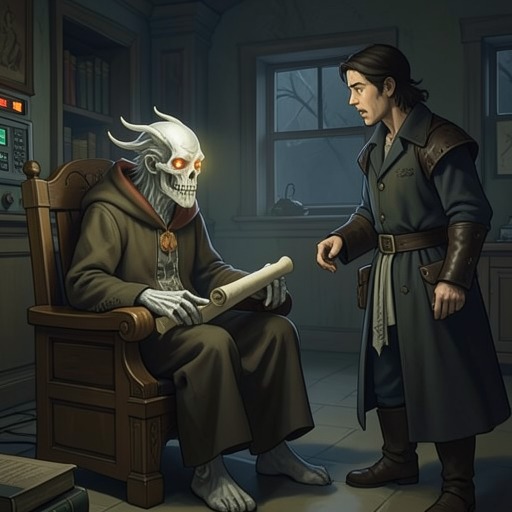
Vainqueur the DragonShadow Fiends are incorporeal, demon-shaped living shadows that serve as some of the strangest and most dangerous attackers in the assault on Murmurin. Their decisive trait is the mismatch between appearance and combatability: they can kill ordinary defenders with lightning, yet arrows, bullets, and other physical weapons pass through them. The encounter establishes them as bodiless souls whose threat depends not merely on strength, but on forcing opponents to discover the correct supernatural means of resistance.
Nature and Classification
Shadow Fiends appear in the battle as ethereal beings shaped like demons rather than as conventional flesh-and-blood monsters. One identified specimen is named Sombreux and classified as a Shadow Fiend of the Demon category. The classification places the creature within the demonic side of the world’s monster taxonomy, while its shadowy, living-phantom form distinguishes it from demons that can be met with ordinary weapons.
Their incorporeal nature grants them immunity to physical attacks. This is not presented as a temporary defense or an armor-like property: the creature is a bodiless soul, so material weapons have no normal body to strike. That condition explains why the attackers can remain exposed in the middle of a melee while conventional soldiers are unable to harm them.
Abilities and Resistances
The Shadow Fiends attack by casting lightning spells at gnolls and kobolds, killing one target with each strike. Their violence is therefore both magical and immediate; they do not need to close with their victims or expose themselves to physical retaliation. The effect turns the battlefield into a one-sided exchange until the defenders identify a suitable countermeasure.
Their recorded resistances are unusually broad. They are strong against unholy, darkness, frost, physical attacks, and all status effects, making many common offensive approaches ineffective. The combination is especially significant because it blocks both mundane force and several forms of supernatural attack while also preventing status-based disruption.
They are weak against demonslayer powers, holy effects, light, necromancy, and magical effects. The weakness list does not make them generally fragile; it specifies a limited set of compatible forces capable of reaching an incorporeal target. In practical terms, the creatures’ power comes from denying access to those methods and exploiting the defenders’ initial dependence on weapons.
Assault on Murmurin
The Shadow Fiends join a wider attack in which many different forces fight together. Vainqueur Junior and other mimics seize elves and swallow them, while the Shadow Fiends strike from a less tangible mode of combat, directing lightning at gnolls and kobolds. Their presence creates a sharp contrast within the same melee: mimics can consume enemies physically, but the shadows can kill without being touched by the weapons aimed at them.
Red and the Kobold Rangers attempt to answer the threat with arrows and musket bullets, but the projectiles phase through the creatures. Red then reports to Victor Dalton that their weapons cannot hit the shadows. The failed volleys serve as a concrete demonstration of the Shadow Fiends’ incorporeality and force the defenders to abandon ordinary battlefield assumptions.
Only Chocolatine, while retaining her human form, and the priest of the Moon Man manage to strike the Shadow Fiends, using light spells. Their success confirms that magic, rather than physical force, is the relevant category of response. Chocolatine’s ability is particularly important because it gives the defenders a working counterattack before Victor Dalton examines the creature’s more specific properties.
Defeat and Narrative Significance
Victor Dalton uses Monster Insight on the nearest Shadow Fiend and learns both its classification and its weaknesses. The discovery changes the battle from helpless defense to tactical experimentation: instead of continuing to waste arrows and bullets, Victor Dalton can test the listed supernatural vulnerabilities.
When Victor Dalton charges the shadow and cuts it with his weapon, the Shadow Fiend initially laughs off the blow. The apparent failure is deceptive. The strike activates his Helheim and Steal Life abilities, dragging the shadowy monster into his scythe despite its immunity to ordinary physical attacks. The scene therefore distinguishes between a weapon’s conventional damage and an ability capable of overriding the creature’s bodily absence.
The encounter makes Shadow Fiends a compact expression of the setting’s game-like combat logic. Their identity is not exhausted by the label of demon or by their visual resemblance to living darkness; their strengths and weaknesses are discoverable rules, and survival depends on reading those rules correctly. Their frightening advantage is consequently reversible, but only after the defenders recognize that the battlefield’s most important fact is not that the shadows are hard to see, but that they cannot be treated as bodies.